Currently Empty: ₹0.00
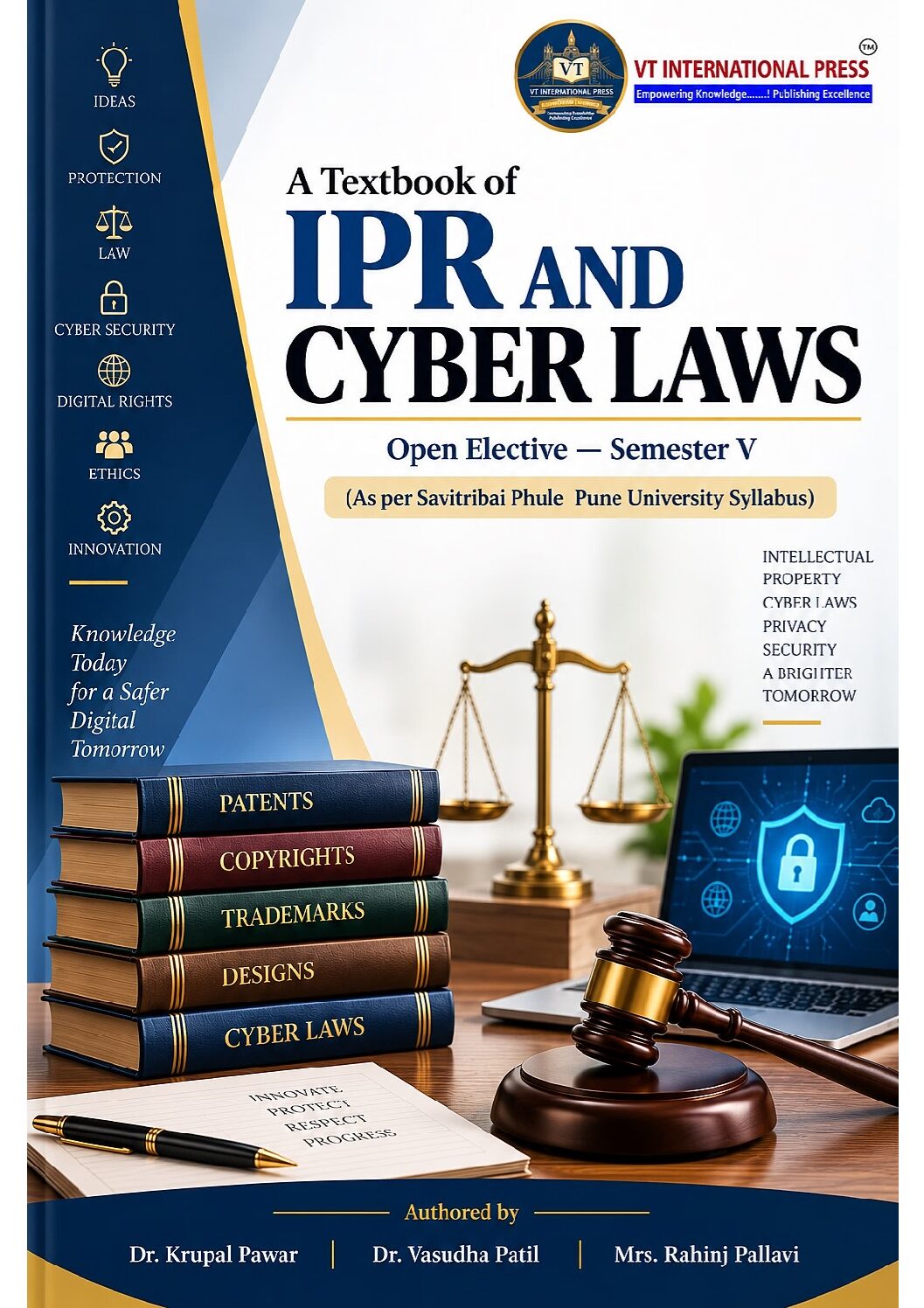
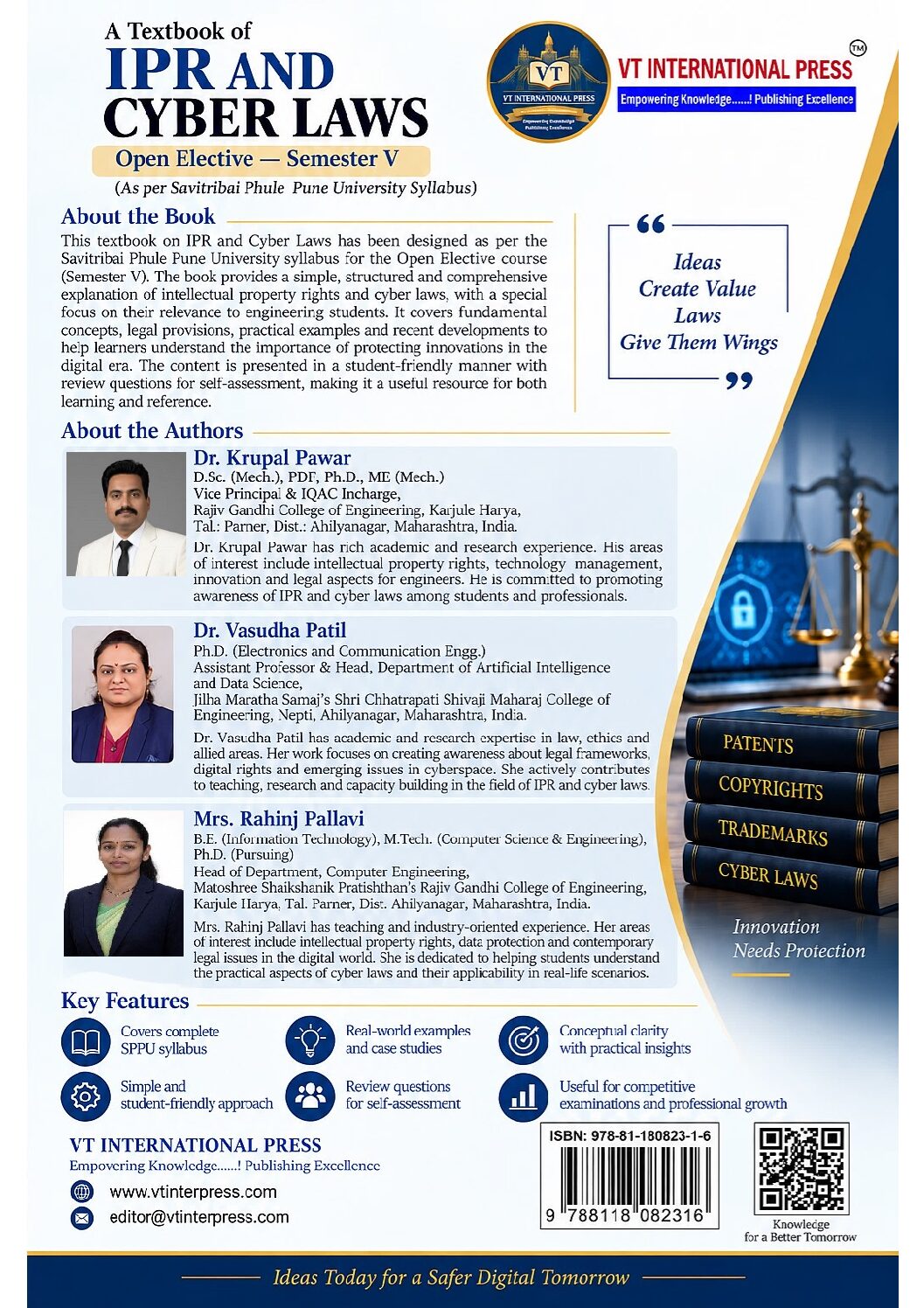
The twenty-first-century engineer works at the meeting point of two powerful legal worlds. The first is the world of Intellectual Property Rights (IPR) — the body of law that turns ideas, inventions, designs and brands into ownable, tradeable assets. The second is the world of Cyber Law — the rules that govern computers, networks, data and the electronic transactions on which modern society now runs. A graduate who understands neither of these is, in a real sense, professionally incomplete. This book was written to fill exactly that gap for students of the Savitribai Phule Pune University (SPPU) Open Elective on IPR and Cyber Laws.
Our guiding conviction while writing has been simple: law can be taught to engineers without diluting it and without drowning them in jargon. Every legal concept in this book is first explained in plain English, then anchored to an engineering situation the student can picture — a motor controller, a mobile app, a chip layout, a smart-grid relay, an IoT sensor. Only after the idea is clear do we introduce the statutory sections, the technical vocabulary and the landmark judgments. We believe a student remembers a principle far better when they have seen it decide a real dispute, so the exact case studies named in the SPPU syllabus are worked through in detail, and many more are supplied in the appendices.
The book follows the prescribed syllabus point by point, in the prescribed order. Unit I builds the conceptual foundation of IPR; Unit II examines the four workhorse rights — patents, copyrights, trademarks and designs; Unit III turns to the business side of IP — licensing, commercialisation, infringement, technology transfer, start-ups and patent searching; and Unit IV opens the world of cyber law, the Information Technology Act, 2000, digital signatures, e-governance, cyber-crime and the protection of connected engineering systems. A rich back-matter — a glossary, a quick-reference table of IT Act sections, a digest of landmark cases, model question papers with answers, and a bank of viva questions — turns the book into a complete self-study and examination companion.
Each unit is designed for roughly six hours of teaching but contains enough depth for self-study, revision and project work. Boxes appear throughout: green Example boxes apply an idea to engineering; amber Note boxes flag examination tips and common confusions; and red Case Study boxes present the judgments the examiner may ask you to discuss. Every unit closes with a summary, a list of key terms, and a graded set of review questions — objective, short-answer and long-answer — so that learning can be tested immediately.
We have tried to be accurate and current, but law evolves through amendment and fresh judgments, and a textbook is a starting point rather than the last word. Students preparing formal answers or professional opinions should always confirm the latest position from the bare Acts, the official IP India and MeitY websites, and their teacher’s guidance. Suggestions for improvement from students and colleagues are warmly invited and will strengthen future editions.
— The Authors
Original price was: ₹800.00.₹600.00Current price is: ₹600.00.



There are no reviews yet.