
Currently Empty: ₹0.00
Every book begins with a question that would not go away. For this one, the question was deceptively simple: how will we keep the coming billions of electric vehicles healthy? We know how to build them — factories around the world now roll them out by the millions. We know, more or less, how to charge them. But maintaining them over a ten- or fifteen-year service life, across fleets scattered over continents and climates, using components whose degradation is invisible to the naked eye — that is a problem we are only beginning to solve.
The traditional answers do not transfer cleanly. Internal-combustion vehicles are maintained on a calendar: change the oil every so many kilometres, replace the belt at a fixed interval, inspect the brakes at each service. This time-based approach is wasteful — it replaces parts that are still healthy — and it is also dangerous, because it misses failures that arrive ahead of schedule. For a battery pack worth a substantial fraction of the vehicle’s value, neither the waste nor the risk is acceptable. We need something better. We need to listen to the machine itself.
That is what predictive maintenance does. It instruments the vehicle with sensors, streams the resulting data through the Internet of Things, and applies artificial intelligence to detect the faint early signatures of impending failure. Done well, it lets us replace a part exactly when it needs replacing — not before, not after. It turns maintenance from a guessing game into a science. And it does so using technologies that, only a few years ago, were confined to research laboratories.
This book is my attempt to explain that whole system, end to end, to a reader who wants genuine understanding rather than buzzwords. I have tried to write it so that it can be read in several ways. The newcomer can read it straight through, and each chapter will prepare the ground for the next. The specialist can dip into the chapters on batteries, or motors, or deep learning, and find self-contained treatments. The manager or policy-maker can read the introductions, summaries, and case studies and come away with a sound mental model without wading through the mathematics.
How this book is organised?
The book is arranged in five parts, moving from foundations to applications to the future:
- Part I — Foundations introduces electric vehicles, the maintenance problem they pose, and the two great enabling technologies: the Internet of Things and artificial intelligence.
- Part II — Sensing and Data examines how we instrument the vehicle, move the data, and prepare it for analysis — the often-underappreciated plumbing on which everything else depends.
- Part III — The Intelligence develops the machine-learning and deep-learning methods that turn data into predictions, including remaining-useful-life estimation and fault diagnosis.
- Part IV — The Vehicle, Subsystem by Subsystem applies these ideas to the battery, the motor and powertrain, the power electronics and charging system, and the thermal, braking, and chassis systems.
- Part V — Systems and the Future covers digital twins, deployment and operations, real-world case studies, cybersecurity and standards, and the road ahead.
Original price was: ₹1,000.00.₹600.00Current price is: ₹600.00.
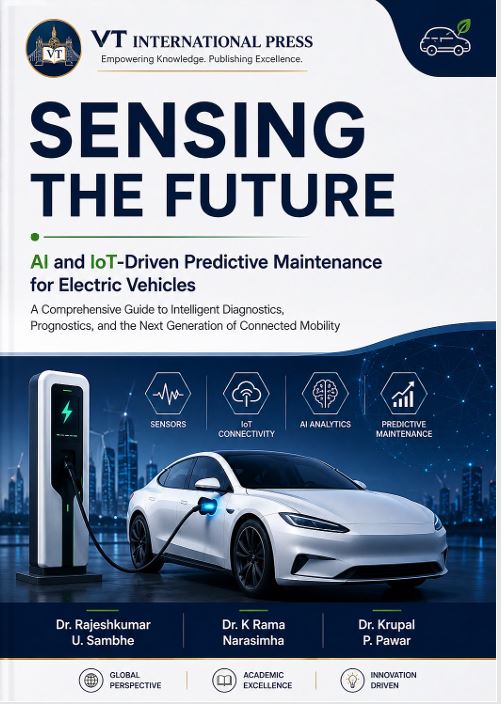
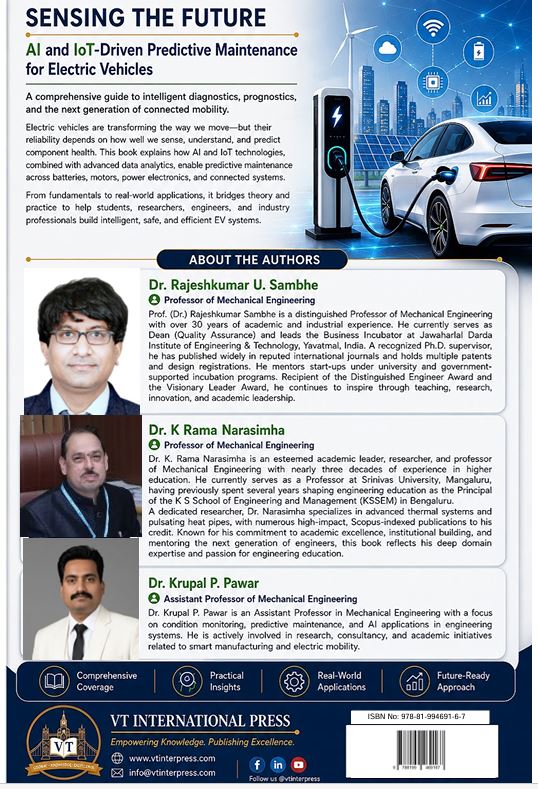
Sensing the Future: AI and IoT-Driven Predictive Maintenance for Electric Vehicles
Every book begins with a question that would not go away. For this one, the question was deceptively simple: how will we keep the coming billions of electric vehicles healthy? We know how to build them — factories around the world now roll them out by the millions. We know, more or less, how to charge them. But maintaining them over a ten- or fifteen-year service life, across fleets scattered over continents and climates, using components whose degradation is invisible to the naked eye — that is a problem we are only beginning to solve.
The traditional answers do not transfer cleanly. Internal-combustion vehicles are maintained on a calendar: change the oil every so many kilometres, replace the belt at a fixed interval, inspect the brakes at each service. This time-based approach is wasteful — it replaces parts that are still healthy — and it is also dangerous, because it misses failures that arrive ahead of schedule. For a battery pack worth a substantial fraction of the vehicle’s value, neither the waste nor the risk is acceptable. We need something better. We need to listen to the machine itself.
That is what predictive maintenance does. It instruments the vehicle with sensors, streams the resulting data through the Internet of Things, and applies artificial intelligence to detect the faint early signatures of impending failure. Done well, it lets us replace a part exactly when it needs replacing — not before, not after. It turns maintenance from a guessing game into a science. And it does so using technologies that, only a few years ago, were confined to research laboratories.
This book is my attempt to explain that whole system, end to end, to a reader who wants genuine understanding rather than buzzwords. I have tried to write it so that it can be read in several ways. The newcomer can read it straight through, and each chapter will prepare the ground for the next. The specialist can dip into the chapters on batteries, or motors, or deep learning, and find self-contained treatments. The manager or policy-maker can read the introductions, summaries, and case studies and come away with a sound mental model without wading through the mathematics.
How this book is organised?
The book is arranged in five parts, moving from foundations to applications to the future:
- Part I — Foundations introduces electric vehicles, the maintenance problem they pose, and the two great enabling technologies: the Internet of Things and artificial intelligence.
- Part II — Sensing and Data examines how we instrument the vehicle, move the data, and prepare it for analysis — the often-underappreciated plumbing on which everything else depends.
- Part III — The Intelligence develops the machine-learning and deep-learning methods that turn data into predictions, including remaining-useful-life estimation and fault diagnosis.
- Part IV — The Vehicle, Subsystem by Subsystem applies these ideas to the battery, the motor and powertrain, the power electronics and charging system, and the thermal, braking, and chassis systems.
- Part V — Systems and the Future covers digital twins, deployment and operations, real-world case studies, cybersecurity and standards, and the road ahead.



There are no reviews yet.